 |
 |
| Reflecting on the Thrombosis & Hemostasis Summit of North America (THSNA) |
|
|
|
|
| The THSNA annual meeting in Portland, Oregon brought forward important conversations highlighting the evolving needs of people living with hemophilia A. |
| One theme stood out—despite treatment advancements, bleeds are still happening. |
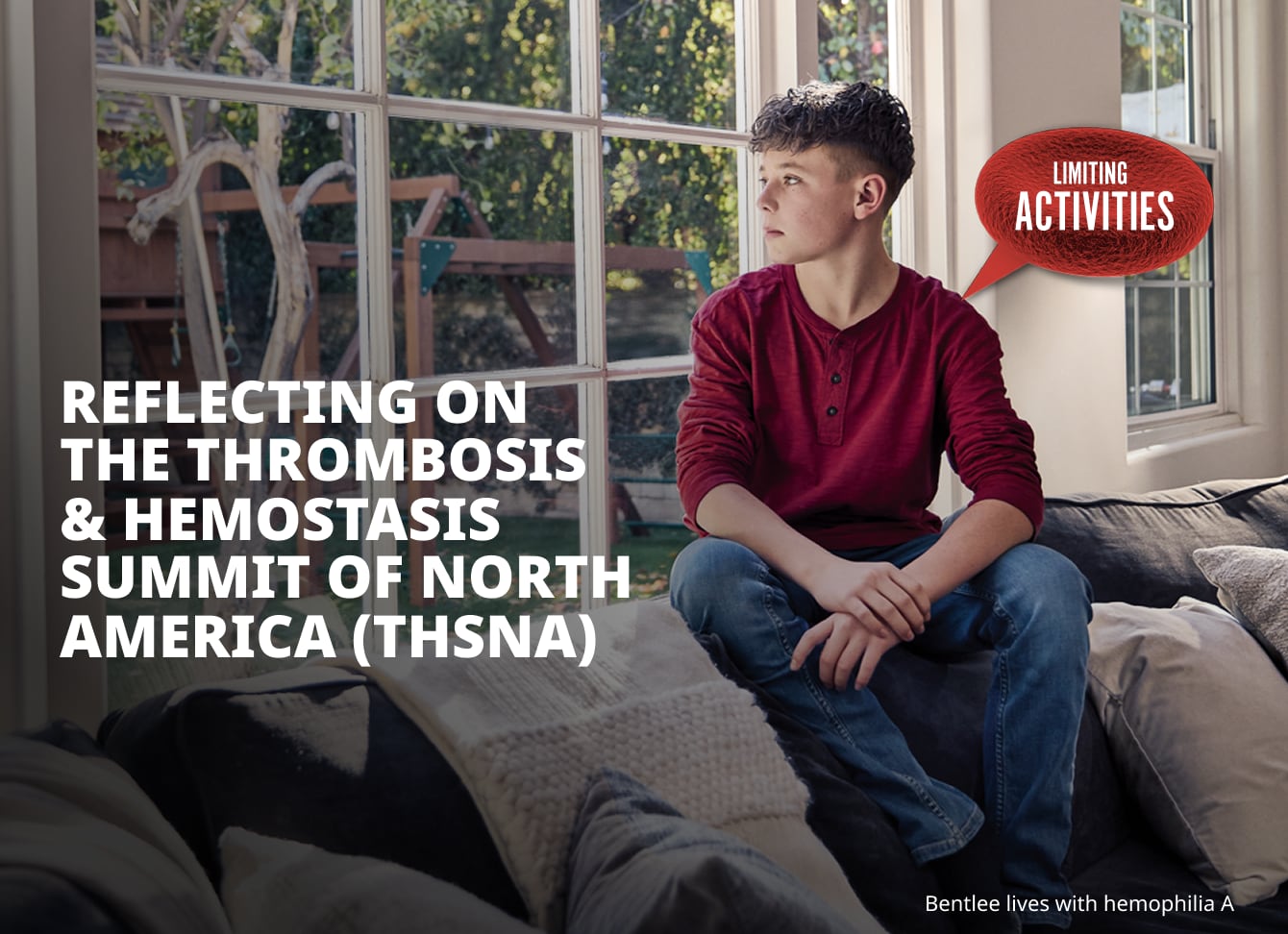
| Do patients feel limited in their daily lives? |
| In a secondary analysis of data from a real-world study of 431 adults with hemophilia A |
| Patients on FVIII mimetic (N=43) reported a |
| 29% |
|
 |
| Patients on FVIII prophylaxis (n=210) reported a |
| 30% |
|
| Loss of ability to do daily activities1,a |
| Responses to survey question: “During the past seven days, how much did your hemophilia affect your ability to do your regular activities, other than your paid job? Patients responded on a scale of 0 to 10, where 0 is ‘hemophilia has no effect on my daily activities’ and 10 is ‘hemophilia completely prevented me from doing my daily activities.’ |
| Study Design1 |
| Secondary analysis of data collected as part of a repeated cross-sectional, retrospective observational study of 431 adult patients with hemophilia A in the US. Data collected as part of the CHESS US data platform were used from 2019, 2023, and 2024. Information was collected using two questionnaire forms: a web-based 'case record form' (CRF), completed by physicians, and a 'patient and public involvement element' (PPIE) completed by patients. Limitations included the retrospective, non-interventional design and voluntary participation, which may introduce selection and recall bias. |
| This underscores the need to look beyond clinical outcomes and support more meaningful management conversations. |
|
|
| aSecondary analysis of data collected as part of a repeated cross-sectional, retrospective observational study of adult patients with hemophilia in the US. Data collected as part of the CHESS US data platform were used, encompassing 2019, 2023, and 2024 waves. The analysis was carried out on 655 patients with hemophilia, including those with hemophilia A (N=431). The aim of this analysis was to estimate the indirect and societal cost burden of hemophilia in the United States. Activity impairment was measured by the degree to which hemophilia affected the patient’s ability to do their regular activities, other than working at a paid job, in the last 7 days, rated on a scale of 0 to 10, where 0 is ‘hemophilia had no effect on my daily activities’ and 10 is ‘hemophilia completely prevented me from doing my daily activities’. Limitations included the retrospective, non-interventional design and voluntary participation, which may introduce selection and recall bias. |
| CHESS=Cost of Haemophilia in Europe: a Socioeconomic Survey |
| References: |
| 1. |
Data on file. Novo Nordisk Inc; Plainsboro, NJ. |
|
|
| Please do not respond to this email. If you would like to contact us, please click here or call 1‑877‑744‑2579. |
| UNSUBSCRIBE NOTICE |
| If you no longer want to receive communications from Novo Nordisk, click here to unsubscribe. You also may call us at 1-877-744-2579 or send us a letter that includes your full contact information (eg, name, email address, phone) to Novo Nordisk, 800 Scudders Mill Road, Plainsboro, New Jersey 08536. To better understand how Novo Nordisk values your privacy, see our Privacy Statement. |
|
Novo Nordisk is a registered trademark of Novo Nordisk A/S.
Non-US Health Care Professionals, please go to pro.novonordisk.com.
© 2026 Novo Nordisk All rights reserved. US25HRBD00443 January 2026 |
 |
|
|
|